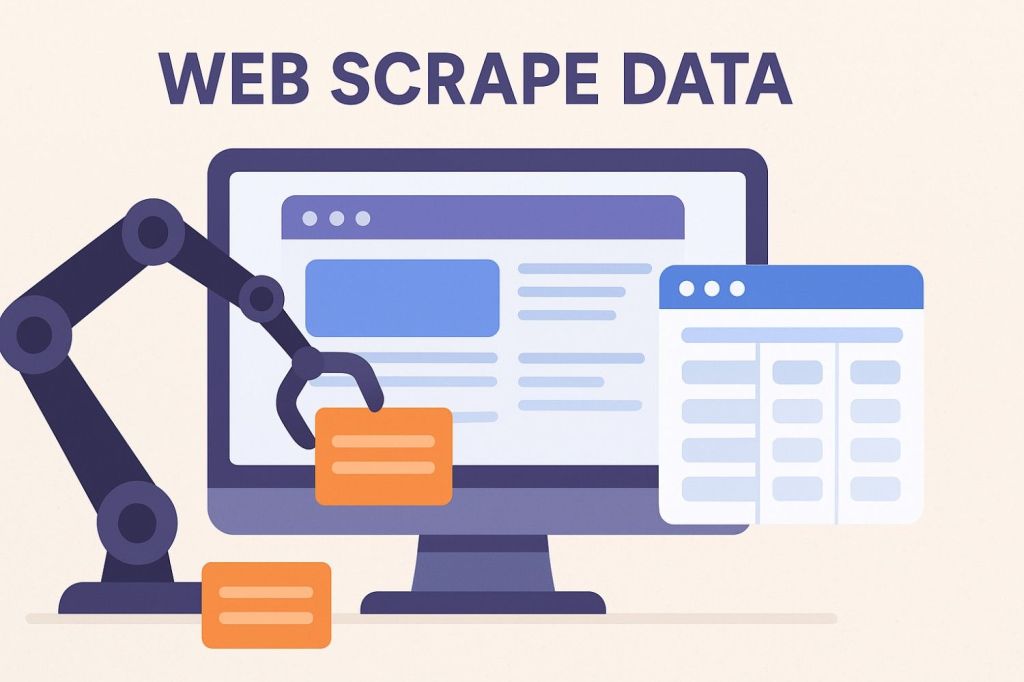
At Kanhasoft we’re often asked: “Can we just grab data off the web and magically turn it into insight for competitive intelligence?” The short answer: yes (but it’s not exactly magic). The longer answer: yes — and if you follow our roadmap below you’ll do it cleanly, legally, and with fewer headaches than those “quick hack” browser-scraping scripts that crash at 2 a.m. (we’ve been there).
Here’s how we approach Web Scraping for competitive intelligence (with our signature parenthetical asides, self-derision, and just enough sarcasm to keep it real).
Web Scraping for Competitive Intelligence: What We Mean
When we talk about “Web Scraping for Competitive Intelligence” we mean the process of extracting relevant data from websites (and sometimes APIs) in order to monitor your competitors, understand market shifts, track pricing changes, spot emerging products or features, and generally gain an edge that isn’t buried in expensive reports. It’s about turning raw web pages into actionable insight.
At Kanhasoft, we emphasise structured data extraction, ETL (Extract, Transform, Load) pipelines, and legal compliance — because yes, you can scrape without getting on the wrong side of ToS or GDPR (especially in the UK, EU, UAE, Israel). We’ve done it (multiple times) so we speak from experience (and from that moment when our first scraper looped until it crashed — lesson learned).
Why Competitive Intelligence Matters (and Why Web Scraping Helps)
Picture this: you’re sipping your coffee (or chai, depending on location) and your competitor quietly lowers their price, tweaks their feature list, or rolls out a “limited-time” offer. If you’re not watching, you’re reacting after the fact. Competitive intelligence flips that. You anticipate, you monitor, you decide — rather than scramble.
Web scraping becomes your digital lookout tower. You pull in data daily (or hourly), spot trends, and you act with confidence. At Kanhasoft we’ve used web scraping to track e-commerce pricing in the UAE, product feature updates in the UK/US markets, and even persona-shifts in smaller niche verticals. Having the data before your rivals often means you win the conversation — and hey, that’s always been our kind of fun.
Legal & Ethical Ground-Rules (because yes, we’ll spoil the fun if you ignore them)
Before you dive in head-first, a quick (but important) reality check. Just because you can scrape doesn’t mean you should ignore the rules. At Kanhasoft we emphasise:
-
Review the website’s robots.txt (and the Terms of Service). Yes, it’s boring, but better than a cease-and-desist.
-
Scrape responsibly: set reasonable crawl rates, respect server load, exclude private/behind-login content unless you have express permission.
-
For global operations (US, UK, Israel, Switzerland, UAE) you might hit data-protection or competition-law issues; make sure you’re compliant.
-
Store and process data securely. If you gather competitor pricing or customer sentiment you’re dealing with business-sensitive info — treat it accordingly.
-
Avoid scraping personal or individually identifiable information unless you’re absolutely sure of your legal basis.
We once (yes, we admit) kicked off a project where we skipped a few of these rules and swiftly got flagged by the target site’s anti-bot system. Lesson: better to play it smart from the start than scramble for a workaround at midnight.
Step-by-Step: How We Do Web Scraping for Competitive Intelligence
Here’s our typical process at Kanhasoft. It’s repeatable, scalable, and yes, sometimes slightly messy behind the scenes (because real-world projects rarely are perfectly clean). But it works.
Data Goal & Scope Definition
First, we define what we want (and why). Are we tracking competitor pricing? Feature changes? Customer sentiment from reviews? Market product launches? Once that is clear we set boundaries: which websites, which data points, how often.
This step often surprises clients when we ask: “How fast do you need updates? Hourly? Daily? Weekly?” The answer changes tool-choice and infrastructure.
Website Discovery & Mapping
Next we identify target websites, map out the pages/paths that host the data, and test manually (yes, click through once) to understand structure. We note things like: is data loaded via JavaScript? Are there anti-bot protections? Is there an API we can use instead (often smarter).
In one UK project we found the competitor’s pricing table loaded only after a JS call — so our scraper had to handle headless browser rendering (less fun, more complex).
Choose Scraping Tool / Framework
At this point we pick our tools. Some of our favourites:
-
Python + BeautifulSoup + Requests (for simple HTML)
-
Selenium or Puppeteer (for JS-heavy pages)
-
API endpoints or GraphQL (if available — prefer this when we can)
-
Cloud functions + scheduler (for scale)
-
Data storage: SQL, NoSQL, or a data lake depending on volume
We don’t pick everything. We pick the right thing for the job. If you load a heavyweight browser for each page and your target is 10 k pages/day, you’ll burn budget (and coffee) fast.
Extraction & Transformation
Here’s where the scraper gobbles the pages and spits out data (structured tables, JSON, CSV). Then we transform: clean HTML noise, normalise date formats, convert currencies (important for global work), tag competitors, flag product names. Good pipelines have plenty of sanity-checks (duplicate data? missing fields? broken rows?).
At Kanhasoft we often build dashboards early so stakeholders can see the live feed (and yes, we love watching their “ooh, that’s interesting” moment when the data turns up something unexpected).
Load & Analyse
Once data is keyed, we load into our storage/BI system. Then we apply analyses: price trend graphs, feature-trajectory maps, sentiment scoring (if reviews), anomaly detection (oh look, competitor dropped price by 18% overnight).
We then deliver actionable reports. The aim: not just data dumps, but decision-ready insight. Because if you’re drowning in tables you’re not using them.
Automation & Monitoring
We set schedules (hourly, daily), set up error alerts (so scraping didn’t silently fail overnight), and build thresholds/triggers (e.g., competitor price < X triggers email alert). At Kanhasoft we also build dashboards that non-technical stakeholders can use (and yes, we sometimes sneak in a dad-joke parenthesis).
Automation doesn’t mean “set and forget.” We always monitor for website structural changes (those’ll kill your scraper faster than you can blink).
Review, Refine & Maintain
Finally, we revisit: is the data still valuable? Are we capturing new competitors? Has the target site changed? Is the business question still relevant? Your competitive intelligence program must evolve. We’ve seen clients stop refreshing after six months and find their dashboards uncontrollable silos. Don’t let that happen.
Tools & Platforms We Trust (and Have Smuggled Through Coffee-Breaks)
Here are some of our go-to tools for web scraping and intelligence work:
| Tool | Use Case | Strength |
|---|---|---|
| BeautifulSoup + Requests (Python) | Simple HTML scraping | Lightweight, easy to customise |
| Selenium / Puppeteer | JS-heavy / dynamic pages | Real browser rendering |
| Scrapy (Python framework) | Large-scale scraping pipelines | Built-in scheduling, pipelines |
| Headless Chrome + Cloud Functions | Serverless scraping tasks | Scalable, cost-efficient |
| AWS S3 / Azure Blob + SQL/NoSQL | Data storage | Flexible for ingestion |
| Power BI / Tableau / QuickSight | Visualisation & dashboards | For stakeholders to consume results |
| Cron Jobs / Cloud Scheduler | Automation | Ensures regular data fetch |
| Alerting (Slack/Email) | Monitoring | Keeps you ahead of failures |
We once spent an afternoon debugging a scraper because the target site updated its HTML class names (why yes, this is why we wear coffee stains). The moral: scrape smart and build for change.
Common Challenges & How We Address Them
Here are a few potholes we’ve learned to steer around. Because yes, even we trip up sometimes (and we admit it).
-
Website Structure Changes: Sites change layouts, class names, scripts. Solution: build selectors that are robust (e.g., by XPath, CSS with fallback) and monitor for broken queries.
-
Anti-Scraping Measures / CAPTCHAs: Some sites block bots or throttle IPs. Solution: respect rate limits, use proxies if legal, consider API endpoints, or partner with the site.
-
Data Quality / Duplicates / Missing Fields: Raw scraping is messy. Solution: build data cleaning steps, define required fields, validate each data capture cycle.
-
Scalability / Performance / Cost: Scraping thousands of pages hourly can burn computation cost. Solution: optimise (e.g., incremental scraping), schedule off-peak, use serverless functions.
-
Legal / Compliance Risks: Especially across regions like USA, UK, UAE, Israel, Switzerland. Solution: consult legal, respect website terms, anonymise if needed, ensure you don’t scrape sensitive PII.
-
Actionability: “We gathered 200 000 rows of data” doesn’t help if you can’t act. Solution: tie each scraping project to a business question, deliver dashboards & alerts, not just CSVs.
Example Use-Case: Pricing Intelligence for E-Commerce in UAE
We once worked with a client in the Middle East (UAE) who sold smart home devices. Their questions: “Are competitors discounting? Which features are newly included? Are bundles appearing elsewhere first?” We used web scraping to monitor 12 competitor websites daily.
Implementation details:
-
Scraped product listings, price changes, bundle offers.
-
Normalised currency (AED / USD) and date/time of changes.
-
Set alert: if any competitor dropped price > 10% we notified the product team.
-
Built dashboard for C-suite: “price drop heat-map”, “bundle changed this week”, “feature addition snapshot”.
Outcome: Within 30 days the client identified a competitor promotion early — adjusted their inventory offer and beat the market by 48 hours. Was it magic? No. Was it data-driven and effective? Yes.
Best Practices We Always Recommend
To wrap up the process, here are some best-practices the Kanhasoft team swears by (yes, we have a white-board full of these).
-
Document your target definitions, scraping schedule, and monitoring strategy.
-
Start small (one site, one data point), then scale. Early wins build momentum.
-
Respect site owners (crawl rates, polite user-agent, follow robots.txt).
-
Build error alerts from day one. A failed scraper can silently destroy your insight pipeline.
-
Keep your data schema consistent. Ambiguity = confusion.
-
Visualise for stakeholders. Raw data is only as useful as how you show it.
-
Archive historical data. Competitive intelligence is about trends, not snapshots.
-
Maintain the pipeline. Sites change. Get ahead of that.
-
Tie everything back to business value. If you can’t act on a data insight, you’re just collecting noise.
When Web Scraping Isn’t Enough (and What to Do)
Now, full disclosure: web scraping isn’t a panacea. Sometimes you’ll hit limits. Here are cases and our alternatives.
-
If you need deep behind-login data or APIs needing keys: Consider a data-sharing agreement or partner access.
-
If real-time, low-latency data is required (sub-minute): Scrapers may be too slow; streaming APIs or data feeds may be better.
-
If data is highly regulated (PII, health data, financial markets): Use cautious legal review, anonymised extraction, compliance check.
-
If the website forbids scraping: Explore official API, or shift to publicly available data (press releases, regulatory filings, market-places).
In short: know when to scrape, and know when to step back and rethink. At Kanhasoft we always advise clients: “Scraping is a tool, not a strategy.”
Integration with Overall Competitive Intelligence Strategy
Web scraping is just one piece of your CI (Competitive Intelligence) puzzle. To get real value:
-
Combine scraped data with surveys, expert interviews, market-reports.
-
Use dashboards and alerts integrated into your decision-making workflows (sales, product, marketing).
-
Link insights to metrics (market share changes, pricing elasticity, feature adoption).
-
Build a feedback loop: insights → decision → measurement → refine.
-
At Kanhasoft we often build CI dashboards that blend scraped data, internal data (sales, CRM) and external data (industry reports) for full context.
The Role of Automation & AI in Scaling Web Scraping
Because we’d be hypocritical if we didn’t mention it: yes, web scraping + AI/ML is a strong combo. At Kanhasoft we’ve seen:
-
NLP to classify scraped text (e.g., review sentiment, feature mentions).
-
Computer vision to interpret screenshots when data isn’t text-accessible.
-
Anomaly detection to flag unusual competitor actions (price drop, product removal).
-
Predictive analytics: “If competitor does X, your share may drop Y %”.
So web scraping gives you the data; AI/ML helps you interpret it faster, smarter, and more proactively.
Getting Started Checklist (for your next 30 days)
Here’s our handy checklist to kick-start your web scraping for competitive intelligence:
-
Define your intelligence goal & scope.
-
List target websites + data points.
-
Manually explore 2-3 target sites to understand structure.
-
Choose your scraping tool and set up a prototype (simple extraction).
-
Build data cleaning + normalisation pipeline.
-
Load into dashboard or spreadsheet.
-
Automate schedule + alerts.
-
Monitor first week: resolve failures, refine selectors.
-
Deliver first insight to stakeholders.
-
Review value: if they act on it, scale. If not, adjust scope.
-
Build documentation and maintenance plan.
-
Archive historic data for trend analysis.
Follow this and you’ll be well ahead of the “we’ll look into reports next quarter” crowd.
Final Thought
At Kanhasoft we believe that Web Scraping for Competitive Intelligence is less about “hacking the web” and more about building a disciplined, scalable insight engine. When done right, you’re no longer reacting to competitors—you’re tracking them, learning from them, and staying one step ahead. (Yes, it’s that satisfying.)
So next time you hear someone say “Let’s just check the website manually”, remember: manual is fine for one time. But if you want repeatable edge, you automate, you monitor, you act. And yes — you might laugh a little at how much time you save.
Thanks for reading. As ever, our coffee’s on us (virtually) if you have questions about deploying your own CI scraping engine. Stay curious, stay sharp, and may your dashboards never be calm (because calm means you’re not noticing something).
FAQs
What is web scraping and how is it different from API usage?
Web scraping is the process of retrieving and parsing information from web pages (HTML) or dynamic content, often by simulating a browser or making HTTP requests. Using an API means you’re using a formally-exposed interface designed by the data provider. APIs are usually more stable and reliable; scraping is a workaround when no API (or insufficient API) exists.
Is web scraping legal for competitive intelligence?
It can be legal, but it depends on the website’s terms of service, the data being scraped, and regional regulations (especially in the UK/EU, UAE, Israel). Best practice: review the site’s ToS, respect robots.txt, avoid protected/private data, and store/process scraped data in compliance with local laws.
How often should I scrape competitor websites?
It depends on your business model and how fast your competitor market moves. For e-commerce and pricing intelligence, hourly or daily may make sense. For slower-moving industries, weekly or even monthly may suffice. The key: align the frequency with your decision-making cycle.
What kind of data is most valuable for competitive intelligence via web scraping?
Some high-value data types include: competitor pricing changes, product launches or removals, feature updates, promotional offers, review and sentiment analysis, market-place availability, geographic expansions, job listings (for signals of strategy shifts). The value comes from actionable insights, not just data volume.
How do we maintain the scraper when websites change?
Set up monitoring/alerts for failures (e.g., pages return 404, selectors produce empty results). Build resilient selectors (e.g., relative XPath, CSS classes with fallback). Schedule periodic manual checks of target sites. Treat your scraping pipeline like production code — because it is.
Can we scale web scraping globally (USA, UK, UAE, Israel, Switzerland)?
Yes — but with additional complexity. You’ll need to consider regional legal/privacy rules, currency normalisation, localisation of websites, proxies/data centres, and potentially language/character-encoding differences. At Kanhasoft we’ve done CI scraping across these regions and built global dashboards accordingly.